

Piper pa-39 twin Comanche
The Piper Twin Comanche was flown by Texans Marion P. Jayne and Patricia Jayne Keefer to victory in the 1994 Round the World Air Race, covering 21,000 miles across 12 days of racing over a 24-day period.
This aircraft was purchased by Marion and George Jayne in 1970 for their family equestrian business. Marion, an accomplished air racer, holds the record for the most cross-country speed air race victories. In 1994, she and her daughter Pat earned FAI Gold Medals as the first mother-daughter team to win the around-the-world race. The aircraft also competed in the 1992 race, making it the only U.S. aircraft and only twin-engine aircraft to race in two around-the-world competitions.
Patricia Jayne Keefer and her husband, Ken, donated the aircraft to LSFM in 2021, honoring Marion’s legacy and supporting the museum’s STEM programs.
August Plane of the Month - North American Aviation P-51D Mustang

North American Aviation P-51D Mustang
One of the most iconic fighter aircraft of World War II, the North American Aviation P-51D Mustang was originally designed in response to a British request for a new fighter aircraft. Powered by the legendary Packard-built Merlin engine, the P-51D featured a distinctive bubble canopy for improved visibility, exceptional speed and maneuverability, and six .50-caliber machine guns, making it one of the most effective Allied fighters of the war. The Mustang earned nearly 4,900 aerial victories in Europe and was widely respected by friend and foe alike.
Following World War II, many surplus Mustangs found new life as civilian aircraft and air racers. This P-51D, N51GE, was built in Inglewood, California, in 1947 and later competed in several air races before being restored. Today it wears its current “Bucket List” paint scheme, applied in 2019, and is on display courtesy of pilot and owner Al Gonsoulin, former President and CEO of PHI Helicopters.
July Plane of the Month - Mooney Acclaim Type S - Model M20TN

Mooney Acclaim Type S – Model M20TN
Recognized as the fastest civilian single-engine piston-powered aircraft in the world, the Mooney Acclaim is a high-performance aircraft built for speed and efficiency. Manufactured in Kerrville, Texas, from 2006 to 2017, this particular aircraft rolled off the production line in 2007, continuing Mooney’s long tradition of aviation innovation.
Founded in 1929 by brothers Albert and Arthur Mooney, the company relocated to Kerrville in 1953 and has achieved several aviation milestones, including developing the first pressurized single-engine aircraft and setting the fastest transcontinental flight in a single-engine piston-powered aircraft. This aircraft is on display courtesy of its owner, Shawn Mills of South Jordan, Utah.
June Plane of the Month - Douglas A-1D Skyraider

Douglas a-1d skyraider
The Douglas A-1D Skyraider was developed as a rugged, carrier-based attack aircraft for the U.S. Navy, first taking flight on March 18, 1945. Designed to carry a wide variety of weapons on its numerous wing hard points, the Skyraider became famous for its ability to carry more ordnance than a World War II B-17 bomber. Between 1946 and 1957, Douglas built 3,180 Skyraiders across 28 different variants.
The Skyraider first saw combat during the Korean War, where its long loiter time and heavy payload capacity provided a significant advantage over early jet aircraft. It later became one of the most successful attack aircraft of the Vietnam War, serving with the U.S. Navy, U.S. Air Force, and South Vietnamese Air Force in close-air support and combat search-and-rescue missions.
The museum’s Skyraider was manufactured in 1952 and served in both the Korean and Vietnam Wars. It initially flew from the USS Philippine Sea, sustaining combat damage multiple times in 1953. From the late 1960s through 1977, it operated in Southeast Asia with the French Air Force before returning to the United States. Today, this airworthy aircraft is owned by the Vietnam War Flight Museum and stands as a powerful reminder of the Skyraider’s remarkable combat legacy.
May Plane of the Month - Beechcraft T-34B Mentor

Beechcraft t-34b mentor
The Beechcraft T-34B Mentor was developed as a primary flight trainer for the U.S. Air Force, Navy, and Marine Corps, derived from the Beechcraft Bonanza Model 35. Built by Beechcraft between 1953 and 1959, the T-34B featured Navy-specific modifications such as differential braking, increased wing dihedral, and adjustable rudder pedals.
Serving as the U.S. Navy’s primary trainer for 20 years, the T-34B logged over 100,000 flight hours annually and became a widely used training aircraft around the world, with licensed production in Japan, Canada, and Argentina.
This aircraft is owned by LSFM Board Member, Chad Thumann of Pearland, TX.
April Plane of the Month - De Havilland Canada DHC-2 Beaver

De Havilland Canada dhc-2 Beaver
The De Havilland Aircraft Company of Canada, LTD. decided after WWII to design an aircraft incorporating comments and requirements from civilian operators. The result was an excellent short take-off and landing (STOL) aircraft well suited for “bush” flying. On August 16, 1947, the DHC-2 Beaver first flew, becoming part of a tradition in which the de Havilland Company named their aircraft after animals such as the Otter, Caribou, Buffalo, and Chipmunk.
Often referred to as the “Best Bush Plane Ever,” the DHC-2 Beaver quickly proved its value. Recognizing its capabilities, the U.S. Army ordered 968 of the 1,691 Beavers produced, designating it the L-20 and later redesignating it the U-6A in 1962. The aircraft was highly versatile, operating effectively on wheels, floats, or skis, and remained in production until 1967.
This aircraft is owned by LSFM Chief Pilot, Charlie Hainline and LSFM pilot, Philippe Barker.
March Plane of the Month - Yakovlev Yak 52

yakovlev yak 52
The Yakovlev Yak-52 was designed in Russia as a primary and aerobatic trainer, first flying in 1976 and produced in Romania from 1977 to 1998. It’s powered by a 360 HP nine-cylinder Vedeneyev M14P radial engine that turns a two-bladed, counter-clockwise variable pitch propeller. With its tandem cockpit, tricycle landing gear, and inverted oil system allowing up to two minutes of inverted flight, the Yak-52 is a rugged aircraft built for dependable training in challenging environments with minimal maintenance support.
A standout feature is its pneumatic system, which powers engine starts, landing gear, flaps, and wheel brakes. Spherical air bottles behind the rear cockpit, maintained at 145 to 175 PSI by an engine-driven compressor, can also be charged from the ground using a scuba-style air source. Differential braking provides steering on the castering nose wheel, and its semi-retractable landing gear offers added protection in the event of a gear-up landing.
This aircraft is owned by Jerod “Jet Jerod” and Amanda Flohr of Friendswood, TX.
February Plane of the Month - Hughes 500C Helicopter
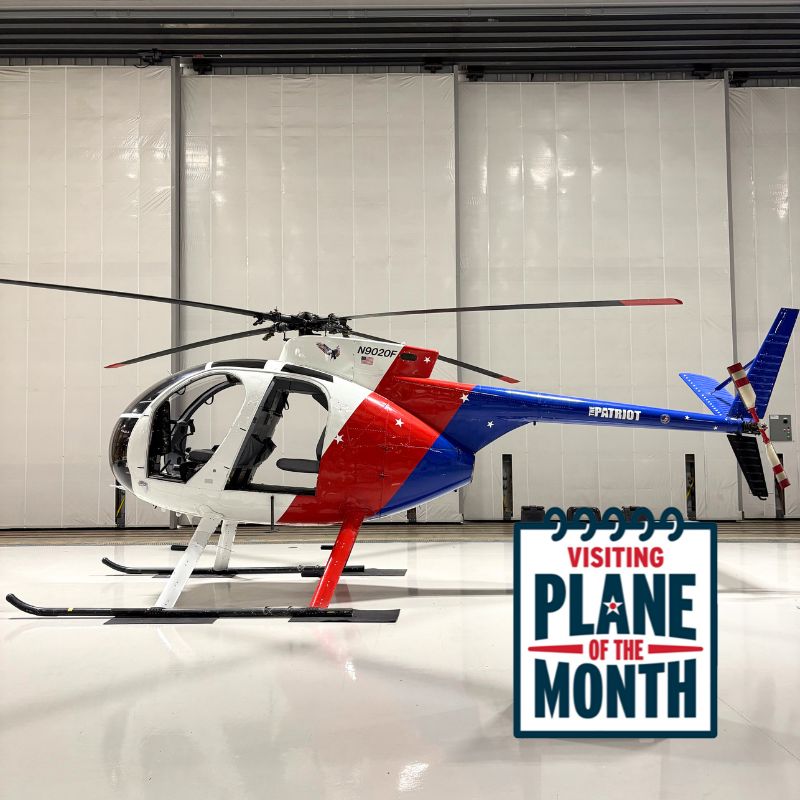
Hughes 500c Helicopter
The Hughes 500C, owned by LSFM Board Member Chad Thumann, was the civilian version of the military OH-6 Cayuse, often called the “LOACH,” a name derived from its classification as a Light Observation Helicopter. Hughes Helicopter produced the civilian version for executive and law enforcement use.
This aircraft, serial number 20, was built for executive and civilian use and also served as a civilian demonstration aircraft, traveling across the country to showcase its capabilities. Known for its speed and maneuverability, the LOACH was used extensively and effectively during the Vietnam War.
January Plane of the Month - Beechcraft BE-200 “Super King Air”

Beechcraft be-200 "super king air"
Part of Beechcraft’s respected family of twin-engine turboprops, this BE-200 belongs to the “Super King Air” series, known for greater capability than the earlier 90 and 100 models. A key design feature is its distinctive T-tail, which improves aircraft stability and control by positioning the horizontal stabilizer above the airflow from the engines and fuselage.
This Super King Air proudly features the colors and logo of the University of Texas, celebrating the alma mater of its owner, Mark Massey. Built between 1974 and 2010, the BE-200 remains one of Beechcraft’s most successful and versatile aircraft, serving military, business, and commuter roles worldwide.